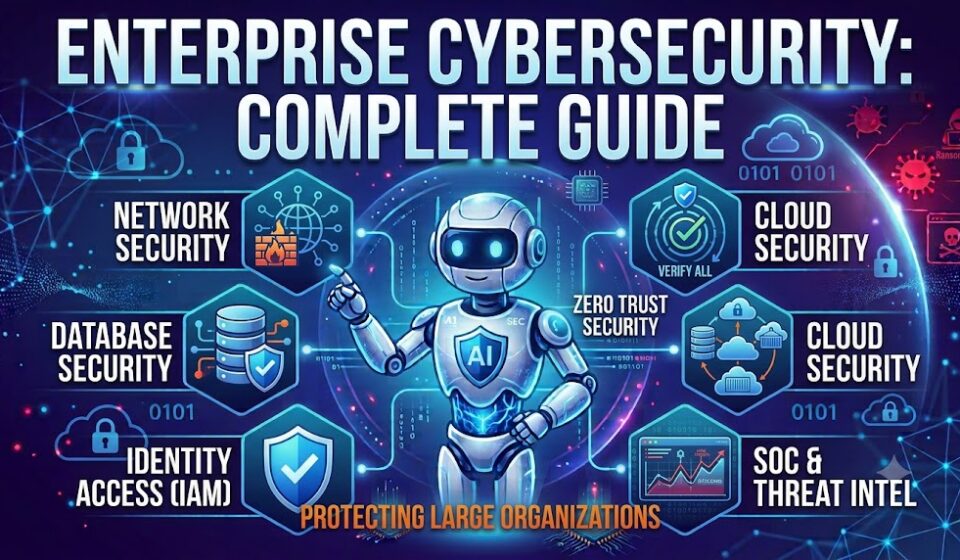

Introduction
In today’s connected business environment, enterprises face increasingly complex cyber threats. Large organizations manage huge amounts of sensitive information, including customer data, financial records, intellectual property, and internal communications.
Cyber criminals often target enterprises because they have valuable digital assets. A successful cyber attack can result in financial losses, operational disruptions, regulatory penalties, and reputation damage.
Enterprise cybersecurity provides advanced security strategies, technologies, and processes to protect large organizations from cyber threats. It combines multiple security solutions to create a strong defense system.
What Is Enterprise Cybersecurity?
Enterprise cybersecurity refers to the security practices, technologies, and policies used by large organizations to protect their digital infrastructure.
It protects:
- Corporate networks
- Cloud environments
- Business applications
- Employee devices
- Customer information
- Company databases
Enterprise cybersecurity focuses on preventing cyber attacks, detecting security threats, and responding quickly to incidents.
Why Is Enterprise Cybersecurity Important?
Large organizations face sophisticated cyber attacks that require advanced protection.
1. Protection Against Data Breaches
Enterprises store massive amounts of sensitive information. A data breach can expose confidential business and customer data.
Enterprise cybersecurity solutions help protect information through:
- Encryption
- Access controls
- Security monitoring
- Threat detection systems
2. Preventing Ransomware Attacks
Ransomware is one of the biggest threats facing organizations today.
Enterprise security solutions help prevent ransomware by:
- Detecting malicious activities
- Monitoring file changes
- Creating secure backups
- Blocking suspicious programs
3. Protecting Remote Employees
Modern enterprises often have employees working from different locations.
Cybersecurity solutions provide secure access through:
- VPN protection
- Multi-factor authentication
- Identity management
- Endpoint security
4. Maintaining Business Continuity
Cyber attacks can interrupt business operations.
Enterprise cybersecurity helps companies continue operations by providing:
- Disaster recovery systems
- Backup solutions
- Incident response plans
Key Components of Enterprise Cybersecurity
1. Network Security
Network security protects enterprise communication systems and internal networks.
It includes:
- Firewalls
- Intrusion prevention systems
- Network monitoring
- Secure access controls
Network security prevents unauthorized access and suspicious activities.
2. Endpoint Security
Every device connected to an enterprise network creates a potential security risk.
Endpoint security protects:
- Employee laptops
- Desktop computers
- Mobile devices
- Servers
It detects malware, unauthorized access, and suspicious behavior.
3. Cloud Security
Many enterprises use cloud platforms to store data and run applications.
Cloud security protects:
- Cloud infrastructure
- Cloud applications
- Virtual servers
- Business data
It includes encryption, monitoring, and access management.
4. Identity and Access Management (IAM)
IAM controls user access to company resources.
Important IAM features include:
- Multi-factor authentication
- User identity verification
- Role-based permissions
- Single sign-on
IAM reduces the risk of unauthorized account access.
5. Security Operations Center (SOC)
A Security Operations Center monitors enterprise systems continuously.
SOC teams:
- Detect cyber threats
- Analyze security alerts
- Investigate incidents
- Respond to attacks
Many large companies operate dedicated SOC teams.
6. Threat Intelligence
Threat intelligence provides information about current cyber risks.
It helps organizations understand:
- New attack methods
- Hacker activities
- Malware trends
- Security vulnerabilities
Enterprise Cybersecurity Technologies
Artificial Intelligence Security
AI-powered cybersecurity systems analyze large amounts of data to detect unusual behavior.
Benefits include:
- Faster threat detection
- Automated responses
- Improved security analysis
Zero Trust Security
Zero Trust is a modern security approach based on continuous verification.
The principle is:
“Never trust automatically, always verify.”
Zero Trust protects enterprises by checking every user, device, and connection.
Security Information and Event Management (SIEM)
SIEM platforms collect and analyze security data from different systems.
They help security teams:
- Monitor threats
- Investigate incidents
- Generate security reports
Extended Detection and Response (XDR)
XDR combines security data from multiple sources to provide advanced threat detection and response.
It improves visibility across:
- Networks
- Devices
- Applications
- Cloud environments
Benefits of Enterprise Cybersecurity
Stronger Threat Protection
Advanced security systems help organizations defend against complex cyber attacks.
Improved Compliance
Enterprise cybersecurity helps companies meet industry security requirements.
Better Risk Management
Security monitoring allows businesses to identify and reduce vulnerabilities.
Increased Customer Trust
Strong cybersecurity practices improve customer confidence.
Reduced Financial Losses
Preventing cyber attacks helps organizations avoid expensive recovery costs.
Common Enterprise Cybersecurity Challenges
Sophisticated Cyber Attacks
Hackers use advanced techniques to bypass traditional security systems.
Large IT Infrastructure
Managing security across thousands of devices and applications is challenging.
Insider Threats
Employees may accidentally or intentionally expose sensitive information.
Skill Shortage
Many organizations face a shortage of skilled cybersecurity professionals.
Enterprise Cybersecurity Best Practices
Businesses should follow these security practices:
- Implement multi-factor authentication
- Regularly update software
- Conduct security assessments
- Train employees about cyber threats
- Use strong access controls
- Monitor systems continuously
- Maintain secure backups
- Create incident response plans
Future of Enterprise Cybersecurity
The cybersecurity industry will continue evolving with new technologies.
AI-Powered Security
Artificial intelligence will improve automated threat detection and response.
Autonomous Security Systems
Future security platforms will automatically identify and resolve many threats.
Cloud-Native Security
More enterprises will adopt security solutions designed specifically for cloud environments.
Advanced Identity Protection
Identity-based security will become increasingly important as digital access grows.